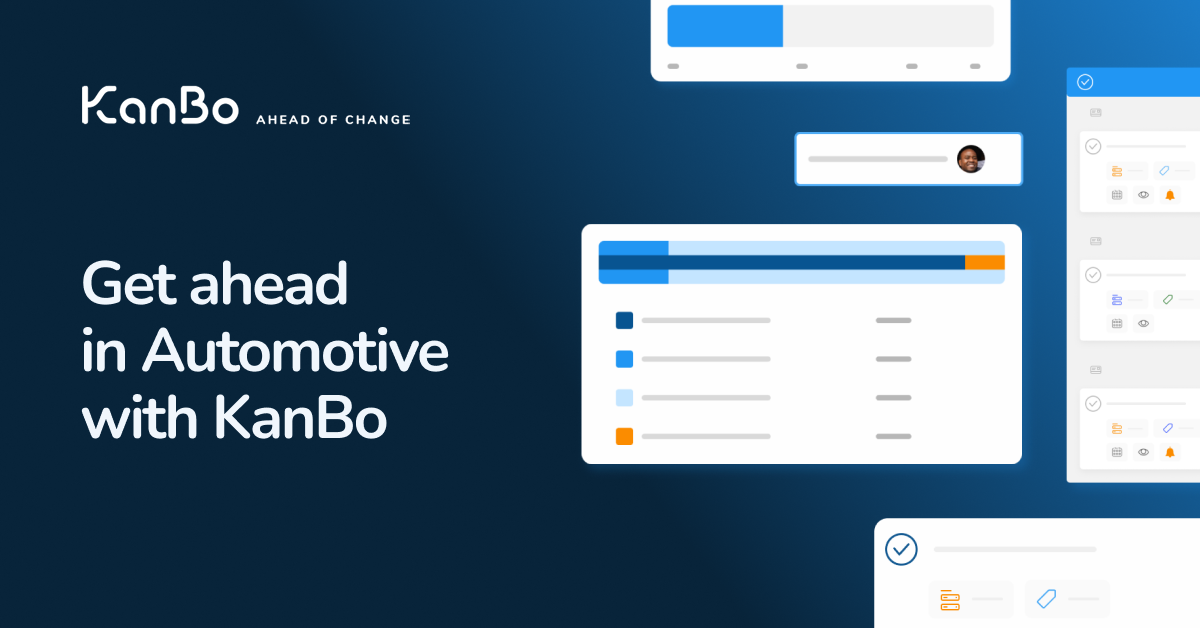
Work coordination platform
Designed for the automotive industry
As a leader in innovation, you understand the importance of staying ahead of the curve in the fast-moving automotive 4.0 world. KanBo provides you with the tools to do just that by facilitating smart factory operations, streamlining project management, fostering collaboration and solving complex problems.

Revolutionizing Work Coordination in Manufacturing: A Comprehensive Guide for Process Engineers on KanBo Platform.
Introduction:
As the business world becomes more complex and interconnected, the need for a work coordination platform has become crucial. KanBo is a platform that provides a comprehensive solution that takes care of all your work needs, from project management to streamlining factory operations. In this article, we will discuss the benefits of using KanBo as your go-to work coordination platform, with a focus on the automotive industry.
Feature Benefits:
KanBo offers a variety of features that work together to create a seamless work experience. Its ease of use allows for a smooth transition from other work coordination platforms. Also, the platform offers advanced communication tools to connect teams, departments, and external stakeholders.
Users can customize their view with cards and boards to match their unique business needs and workflows. KanBo’s intuitive interface helps organizations to organize, collaborate, and enhance their productivity. Some of the key benefits of KanBo include:
1. Project Management: KanBo provides a complete project management solution to optimize resource allocation, task management, and project delivery timelines.
2. Streamlining Factory Operations: KanBo focuses on lean management principles, optimizing production efficiency, and waste reduction to enhance profitability.
3. Collaboration Tools: KanBo encourages cross-functional collaboration between departments, which leads to improved communication and collaboration.
Short Product Tour:
KanBo’s interface is designed to help you get started quickly and efficiently. The platform offers an intuitive drag-and-drop user interface, allowing users to create and manage cards and boards with a few clicks.
KanBo provides advanced tools such as Gantt charts, Kanban boards, and mind maps. The platform enables automatic sync between cards and boards, which helps maintain accurate information across the platform. KanBo also offers excellent analytics capabilities that help organizations to make data-driven decisions.
Focus on Communication in Automotive:
The automotive industry requires highly advanced communication solutions due to its unique set of challenges. KanBo offers a platform that enables automotive manufacturers to organize communication between their operational and support units effectively.
KanBo’s communication tools facilitate collaboration between departmental silos. The platform developed by KanBo focuses on real-time communication and sharing of information. The platform enables smooth collaboration across various stages of the automotive value chain.
Conclusion:
KanBo is a powerful platform that provides a work coordination solution to businesses across all industries, with a particular focus on the automotive industry. KanBo’s lean manufacturing principles, project management capabilities, and cross-functional collaboration tools make it the perfect choice for large enterprises looking for a comprehensive work coordination platform. With KanBo, you can optimize productivity, enhance resource allocation, and streamline your processes for greater success.
One week of life Manufacturing Process Engineer in Automotive industry with KanBo:
Monday – Start of the week
1. Check notifications and emails in KanBo
2. Review project progress in Kanban view and update status of cards accordingly
3. Collaborate with cross-functional team using @mentions and comments on cards
4. Use KanBo’s Gantt chart view to track project timelines and adjust as necessary
5. Attend daily team stand-up meeting and update KanBo cards with any new information
Tuesday – Production Planning
1. Plan production schedules using KanBo’s calendar view
2. Assign resources to production tasks using KanBo’s resource management feature
3. Update KanBo cards with production plans and share with team for feedback and adjustments
4. Collaborate with procurement team on material availability and ordering using KanBo’s document groups and references
Wednesday – Quality Control
1. Use KanBo’s checklist feature to document and track quality control procedures
2. Assign specific QC tasks to team members using KanBo’s card assignment feature
3. Use KanBo’s activity stream to track progress of QC tasks in real-time
4. Review and analyze data collected during QC process in KanBo’s spreadsheet view
Thursday – Process Improvement
1. Identify areas for process improvement using KanBo’s activity view and data analytics features
2. Collaborate with team to develop and implement process improvement strategies using KanBo’s card templates and blockers
3. Use KanBo’s mind map view to visualize process flow and identify potential bottlenecks
4. Document process changes using KanBo’s document folders and versioning feature
Friday – Project Wrap-up
1. Use KanBo’s dashboard and reporting features to analyze project success and identify areas for future improvement
2. Collaborate with team to document and share lessons learned using KanBo’s Notes feature
3. Conduct post-project review meeting with team and stakeholders, and update KanBo cards with any final feedback or learnings
4. Archive project cards and documents in KanBo’s Spaces feature for future reference and knowledge sharing.

Yes, KanBo is much more than just a tool for communication. While it does provide an excellent space for teams to easily and effectively communicate with one another, KanBo also offers many other features that help optimize and streamline work management. These additional features include:
1. Document management: KanBo provides multiple document sources in spaces, document groups, and folders, as well as document versioning and document references. This means that teams can easily organize and manage all their important documents within KanBo, ensuring that everyone has access to the most up-to-date information.
2. Card management: KanBo’s “cards” provide a robust system for managing tasks, assigning team members, scheduling deadlines, and tracking progress throughout the lifecycle of a project.
3. Visual representation of work: KanBo offers various views like Kanban view, list view, table view, calendar view, Gantt chart view, timeline view and mind map view to visualize work and progress.
4. Resource management: KanBo helps organizations manage resources during project life cycle, it provides an overview of the availability of each person on the project team, makes it easy to assign tasks, track progress, and ensure that no one is overloaded with too much work.
5. Collaboration: KanBo fosters collaboration by providing a space for team members to communicate, stay up-to-date, and share feedback on project progress.
All of these features work together to create a comprehensive and streamlined work coordination platform that enables teams to work more productively together. So, while communication is certainly a critical component of KanBo, it is just one part of an overall powerful work management solution.
Q&A
Q: What industries can benefit from using KanBo as their work coordination platform?
A: KanBo provides a comprehensive work coordination platform that can benefit businesses across all industries. However, KanBo has a particular focus on the automotive industry, with features and tools that cater specifically to their unique set of challenges.
Q: How does KanBo promote cross-functional collaboration in organizations?
A: KanBo provides various collaboration tools such as @mentions, comments, and document groups that enable cross-functional collaboration between departments. KanBo’s interface is designed to encourage communication and sharing of information, which leads to improved communication and collaboration across an organization.
Q: What benefits does KanBo provide in the automotive industry?
A: KanBo’s work coordination platform offers advanced communication, project management capabilities, and cross-functional collaboration tools that are particularly beneficial in the automotive industry. KanBo focuses on lean manufacturing principles, streamlining factory operations, and collaborating effectively between operational and support units. With KanBo, automotive manufacturers can optimize productivity, enhance resource allocation, and streamline their processes for greater success.
Use Case: Implementing KanBo for Streamlining Production Processes in an Automotive Plant
In an automotive plant, production processes are crucial for ensuring the quality of the product and timely delivery. With KanBo, production managers can streamline their processes and optimize resource allocation. Here’s an example:
Scenario: An automotive manufacturer wants to optimize their production processes for a new line of electric vehicles. They need to standardize their work instructions, design sustainable assembly devices and tools, and introduce new technologies to increase efficiency while maintaining product quality.
Solution:
Define, establish, and optimize production processes (Standard Work Instructions)
– Managers can use KanBo to create Standard Work Instructions for all production processes, ensuring consistency and quality across the plant.
– The platform’s Lean Manufacturing tools, such as VSM and PDCA, can be applied to identify waste and improve workflow.
Select, define (or design), acquire, improve, and define sustainability process for assembly devices (fixtures, templates, gauges, mobile equipment) and tools (electrical, controlled torque and / or manual) for new operations of the assembly production lines
– KanBo enables the design and definition of sustainable assembly devices and tools, ensuring optimal use of resources.
– Managers can use the platform to plan and organize the acquisition, improvement, and maintenance of assembly devices and tools.
Maintain continuous improvement by introducing new technologies to increase efficiency of production processes
– KanBo’s analytics capabilities allow managers to track and analyze performance metrics, identifying areas for improvement.
– New technologies can be integrated into existing processes through KanBo’s project management functionalities, ensuring the transition is seamless and efficient.
Coordinate with logistics to keep all production areas updated, define materials location in the production line and provide the control means in order to handle them better
– KanBo can be used to organize communication between logistics and production departments, ensuring effective coordination and timely delivery of materials.
– Managers can use the platform to define and document the location of materials in the production line, keeping the inventory organized and optimizing use of space.
Communication with customers
– KanBo’s incoming email functionality allows customers to communicate with production teams directly, providing quick and efficient feedback.
– Managers can use KanBo to analyze customer feedback and improve the customer experience.
Using Microsoft Office Skills with KanBo – Sending Emails to KanBo Card or Board
– KanBo’s integration with Microsoft Office tools, such as Outlook, enables users to send emails directly to a KanBo Board or Card.
– Emails can be automatically converted into new cards or added to existing ones, streamlining communication and documentation processes.
Conclusion:
KanBo is a versatile work coordination platform that allows automotive manufacturers to optimize their production processes, enhance collaboration, and improve product quality. With KanBo’s features, managers can standardize work instructions, design sustainable assembly devices, and introduce new technologies to increase efficiency. KanBo also enables effective communication with logistics departments and customers. By using KanBo, automotive plants can achieve greater productivity, profitability, and customer satisfaction.