Work coordination platform
Designed for the automotive industry
As a leader in innovation, you understand the importance of staying ahead of the curve in the fast-moving automotive 4.0 world. KanBo provides you with the tools to do just that by facilitating smart factory operations, streamlining project management, fostering collaboration and solving complex problems.
How KanBo is Revolutionizing the Work Coordination for Large Enterprises: Insights from the Head of Change Management and Communication in the Transformation Office Finance & Controlling
In today’s fast-paced business environment, efficient communication and collaboration are critical to success. This is especially true for large enterprises, where teams are spread across different locations and must coordinate their efforts to manage complex projects. Enter KanBo, the work coordination platform designed specifically for large enterprises.
KanBo is a comprehensive tool that facilitates smart factory operations, streamlines project management, and solves complex problems. It brings together all the employees, departments, and external stakeholders in large enterprises, providing a unified platform for collaboration and communication. With KanBo, teams can communicate and work together seamlessly, regardless of their location or time zone.
One of the core features of KanBo is its on-premises and cloud installations and licenses. This flexibility allows KanBo to cater to the needs and preferences of every type of business. Whether you run a large multinational corporation or a small startup, KanBo can be customized to suit your specific requirements.
KanBo is particularly well-suited for the automotive industry, where collaboration and communication are key to success. The Transformation Office Finance & Controlling uses KanBo as a tool to coordinate all transformation initiatives across the board. Together with all FC departments, they are making FC fit for the future. By working with KanBo, they can shape the further development and drive forward the implementation of the FC Target Picture with FC products and processes as well as digitization together with the departments in FC. These activities are supported by their Change Management and Communications team.
The Change & Com team plays a crucial role in the FC transformation, supporting changes in roles, tasks, and collaboration models through consulting and the development, implementation, and controlling of appropriate change and com measures. They are using KanBo to manage all relevant interfaces and stakeholders and control service providers. They are also using KanBo to prepare and content-related pre-control committee meetings and events. The result is a more effective, efficient, and collaborative workflow that enhances the overall performance of the organization.
In summary, KanBo is a powerful work coordination platform designed for large enterprises. Its on-premises and cloud installations and licenses make it a versatile tool that can be customized to fit the needs of any business. For the automotive industry, KanBo is an essential tool that streamlines project management, facilitates collaboration, and solves complex problems. By using KanBo, large enterprises can work more efficiently and effectively, achieving greater success in today’s competitive business environment.
As a Head of Change Management and Communication in the Transformation Office, your role is critical in ensuring smooth operations in the fast-paced automotive industry. One tool that can help you stay on top of your tasks and schedules is KanBo. In this guide, we will explore how to use KanBo in a typical week for a Head of Change Management and Communication.
Monday:
Start the week by logging into KanBo and checking your notifications and activity streams. Review your cards and tasks for the week ahead, and prioritize them accordingly. Use the Kanban view to visualize your tasks and move them across stages as you progress.
Tuesday:
Collaborate with your team on a new project by creating a new KanBo card for the project. Assign team members and set due dates. Use the comments feature to communicate and brainstorm ideas.
Wednesday:
Schedule a meeting with the key stakeholders for your ongoing project. Use the calendar view to find a suitable time slot and invite the necessary members. Add the meeting details and agenda to a KanBo card and share it with the attendees.
Thursday:
Review the progress of ongoing tasks and projects by using the Gantt chart view. Identify any delays or bottlenecks and make necessary adjustments. Use the @mentions feature to update the team members accordingly.
Friday:
Wrap up the week by checking your completed tasks and making necessary follow-ups. Create a dashboard to track the progress of your projects and share it with your team members and stakeholders.
By following these simple steps and integrating KanBo into your daily routine, you can improve collaboration, productivity, and communication in your role as the Head of Change Management and Communication in the Transformation Office Finance & Controlling in Automotive industry.
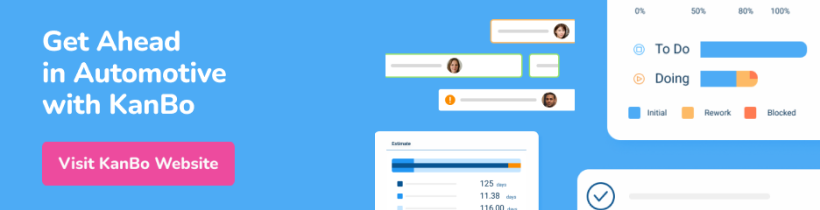
Yes, KanBo is much more than just a tool for communication. While it does facilitate communication and collaboration between team members, it is also designed to optimize work management. KanBo’s features go beyond simple messaging and file sharing, allowing for a more organized and efficient workflow. Here are just a few examples of the many capabilities of KanBo:
– Workspaces and Spaces: KanBo allows for the creation of workspaces and spaces, which can be organized by project, team, department, or any other criteria. Workspaces can contain multiple spaces, and can be customized according to user preferences. This makes it easy to keep work organized and accessible to the relevant team members.
– Card Elements: Cards are a key feature of KanBo, and can be used for tasks, projects, or any other work item. Cards can contain multiple elements, such as checklists, notes, and annotations, which makes it possible to include all relevant information in one place.
– Card Statuses and Blockers: KanBo allows for the creation of custom card statuses and blockers, making it easy to track progress and identify any potential roadblocks. This ensures that work stays on track and that team members are aware of any issues that may arise.
– Document Management: KanBo includes powerful document management tools, allowing users to store, share, and collaborate on documents within the platform. Multiple document sources can be added to spaces, and document versioning ensures that everyone is working on the most up-to-date file.
– Views: KanBo offers multiple views, including Kanban, list, table, calendar, and Gantt charts, making it easy to visualize work in the way that works best for each user. This helps team members stay organized and stay on top of their tasks.
Overall, KanBo is a highly versatile work management platform that goes far beyond simple communication tools. It offers a wide range of features designed to optimize workflow, increase efficiency, and promote collaboration across teams and departments.
Q&A
1. Q: What industries is KanBo best suited for?
A: KanBo is particularly well-suited for the automotive industry and other large enterprises where collaboration and communication are essential for success.
2. Q: How does KanBo support the Transformation Office Finance & Controlling in their goals?
A: KanBo supports the Transformation Office Finance & Controlling by providing a unified platform for collaboration and communication among all departments and stakeholders, streamlining project management, and facilitating problem-solving.
3. Q: How can KanBo improve workflow and productivity in large enterprises?
A: By providing a visual representation of tasks and progress across multiple stages, enabling collaboration and communication across teams and locations, and offering flexible installations and licenses, KanBo can significantly improve workflow and productivity in large enterprises.
Use Case: Leveraging Microsoft Office Skills in KanBo
KanBo is designed to help teams work more efficiently by providing a platform for collaboration, communication, and project management. One of the many advantages of KanBo is that it integrates with Microsoft Office, allowing users to leverage their existing Office skills to get more done in less time.
One example of this integration is the ability to send card comments as email messages. This feature allows users to write a comment or message in a card and mark it for sending to an email recipient. In combination with a public email address of a card, users can communicate with external users, who can reply to the card directly.
To use this feature, users need to enable it as an additional component. Once enabled, they can enter the card, write a comment, and select “Send as email” from the drop-down menu. They will be prompted to create an incoming email address, which users can reply to. Users can then select one or more emails to which their message will be sent and click “Send” to send the message.
The comment will be visible in the card and board’s activity streams, with information about who the message was sent to. Recipients will receive an email from a public card email address, and if the Incoming Emails feature is enabled, they can reply to the email, and their reply will be added to the card in a few minutes.
By leveraging their Microsoft Office skills, users can streamline their communication and collaboration efforts with KanBo, making it easier to work together and achieve their goals. Whether they are sending emails, creating documents, or analyzing data, KanBo and Microsoft Office work together seamlessly to maximize productivity and efficiency.